



Nearly 40 percent of small businesses have less than one month of cash on hand, according to Yahoo! Finance. One in ten says they couldn’t last a week without revenue. That doesn’t mean they’re not profitable or even that they’re doing anything wrong. In fact, issues like this are common among small businesses and can even be a symptom of growth. But unless you find a way to manage it, build a buffer, or obtain external capital, it does mean you’re probably only one emergency or a few late customers away from potentially catastrophic consequences. Thankfully, invoice factoring is easy to qualify for and can serve as an on-demand buffer that shields your business. And if you apply a few advanced invoice factoring techniques on top of it, you can improve your liquidity even more. Give us a few minutes, and we’ll walk you through the basics.
Business Liquidity: A Brief Primer
Liquidity is about access. It tells you how easily your business can meet short-term financial obligations using the resources already available to it. If an unexpected expense came up today or if a great opportunity landed in your lap, how quickly could you access the funds to handle it?
That’s the role of liquidity. It’s one of the clearest indicators of financial health, but also one of the most misunderstood. Let’s unpack what it really means, what it includes, and how it compares to other financial metrics you may be using to gauge your business performance.
Examples of Liquid Assets
Liquid assets are resources your business can convert to cash quickly, without losing significant value. These are the things that keep your operations nimble and responsive.
- Cash on Hand and in Bank Accounts: Funds held in operating or savings accounts are immediately available for expenses such as payroll, rent, and supplier payments.
- Accounts Receivable: Invoices issued to customers represent incoming cash that is expected within a defined payment window.
- Marketable Securities: Short‑term investments can often be sold quickly without a significant loss in value.
These assets can be used to cover payroll, pay suppliers, or seize time-sensitive opportunities.
Examples of Non-Liquid Assets
Non-liquid assets still have value, but they take time to convert into usable cash—and may lose value in the process.
- Inventory: Products held for sale may require time to move or discounts to sell quickly, depending on demand and seasonality.
- Equipment and Machinery: Specialized tools and machinery typically require finding a buyer and negotiating a sale, which can take weeks or longer.
- Real Estate: Property often holds significant value but is rarely practical for addressing short‑term funding needs.
These assets support long-term growth and operations, but they don’t offer the same flexibility as liquid ones.
How Liquidity Compares to Other Financial Measures
Liquidity is often discussed alongside other financial metrics, which can lead to confusion. Each measure provides useful insight, but they answer different questions about your business’s financial position.
Liquidity vs. Profit
Profit shows how much money your business earns after expenses, while liquidity shows how easily you can access usable cash.
- Profit: Earnings may exist on paper while cash remains tied up in receivables, inventory, or long‑term assets.
- Liquidity: Available funds reflect what your business can use immediately to meet obligations or pursue opportunities.
A business can be profitable and still experience tight liquidity if cash is slow to arrive.
Liquidity vs. Cash Flow
Cash flow tracks the movement of money into and out of your business over time, while liquidity focuses on present‑day access to funds.
- Cash Flow: Regular inflows and outflows show whether your business model supports ongoing operations.
- Liquidity: Immediate access to cash determines how comfortably you can manage short‑term commitments.
Strong cash flow trends do not always translate into strong liquidity at every point in the cycle.
Liquidity vs. Working Capital
Working capital measures the difference between current assets and current liabilities, while liquidity focuses on how usable those assets actually are.
- Working Capital: The calculation includes assets that may take time to convert into cash.
- Liquidity: The emphasis is on assets that can be accessed quickly without disrupting operations.
Improving liquidity often involves making working capital more accessible.
How to Improve Business Liquidity
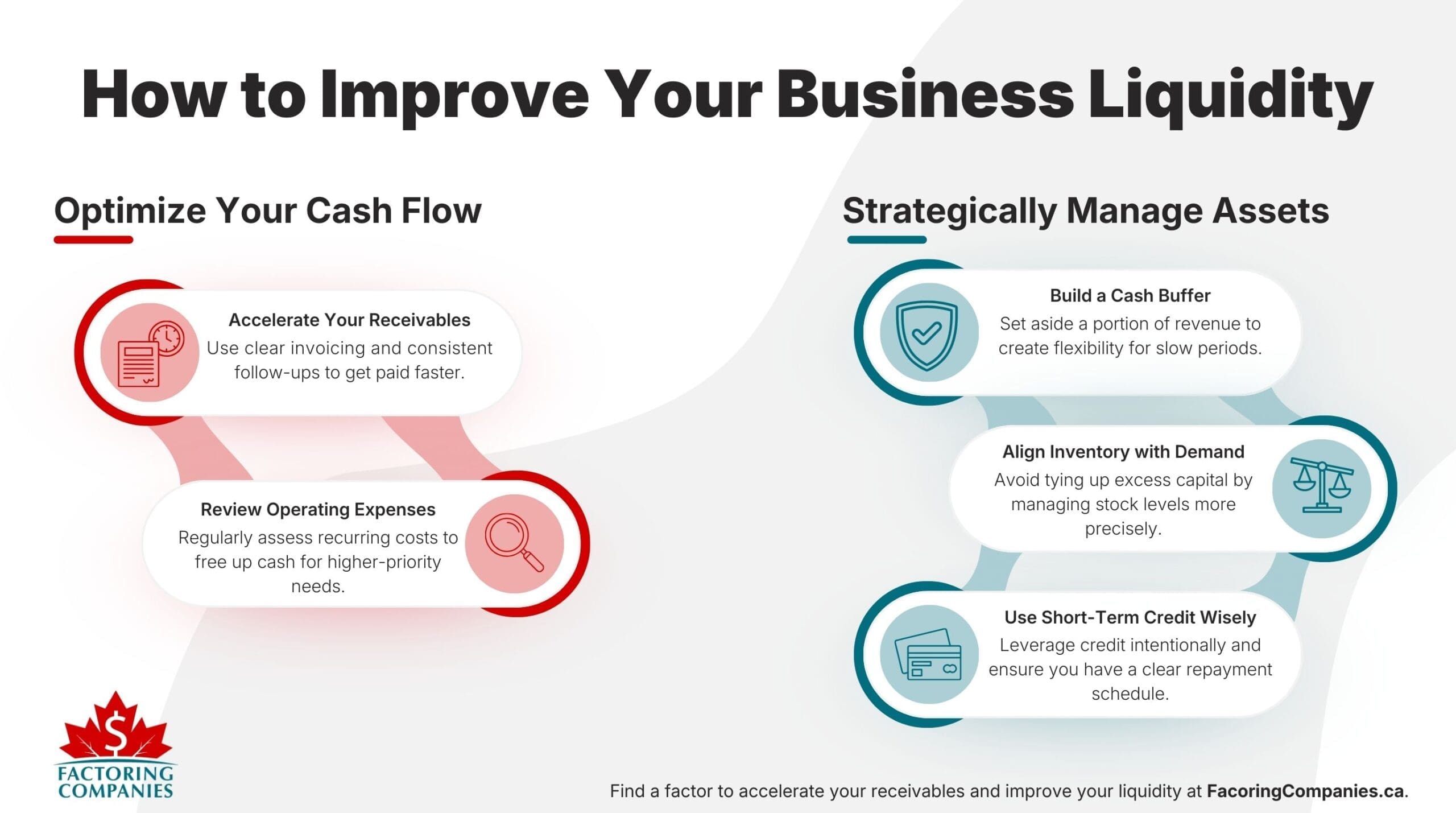
There are many ways to strengthen liquidity without changing your funding structure.
- Speed Up Receivables: Clear invoicing, consistent follow‑ups, and well‑defined payment terms help reduce the time between billing and payment.
- Review Operating Expenses: Regularly assessing recurring costs can free up cash for higher‑priority needs.
- Build a Cash Buffer: Setting aside a portion of incoming revenue creates flexibility during slower periods or unexpected situations.
- Use Short‑Term Credit Thoughtfully: Short-term credit options, like a business credit card or line of credit, can support liquidity when they’re used intentionally and repaid on a clear schedule.
- Align Inventory Levels with Demand: Managing stock more precisely helps you prevent excess capital from being tied up in unsold goods.
6 Advanced Invoice Factoring Techniques to Maximize Liquidity
Earlier, we talked about how speeding up receivables improves liquidity. That’s the role factoring generally plays. It accelerates payment on your B2B invoices and provides you with immediate cash. However, once you’re leveraging factoring, there are many additional techniques you can apply to maximize liquidity.
1. Use Factoring as the Core Layer in a Liquidity Stack
Factoring is often favoured because it can provide you with cash on the same day you submit your invoice, and it doesn’t create debt your business has to pay off. However, as your business grows and needs to tap into greater sums or invest in things like vehicles, machinery, or real estate, you can pair it with other funding solutions, such as equipment financing and traditional loans.
This approach keeps your invoices and the capital they represent free for the times you need fast liquidity, like when a customer is paying slowly, and you need to cover payroll, or you’re ramping up for peak season, and need to stock up and hire quickly.
2. Use Selective Factoring with Tight Rules
Many factoring agreements don’t require you to factor all your invoices. If this is the case for you, you may want to consider factoring selectively, focusing more on the invoices you know will take longer to pay out.
This way, you still get the capital you need when timing matters, but you’ll spend less on fees overall. That frees up more of your cash and helps maximize your liquidity.
3. Shorten the “Submission-to-Cash” Cycle with a Funding Cadence

Instead of holding invoices until the end of the week or sending them in whenever you remember, create a regular cadence. That might mean funding every Tuesday to line up with payroll or twice a week to match outgoing vendor payments.
This helps shorten the time between doing the work and having usable cash in hand. It also creates predictability, which makes it easier to manage short-term needs without relying on other forms of financing. The more consistent your process, the more reliable your liquidity.
4. Negotiate an Advance Rate Ladder
Some factoring companies offer flexibility in how they set advance rates. If you consistently submit high-quality invoices or increase your volume over time, you may be able to negotiate a tiered structure that rewards that consistency.
For example, you might start with an 85 percent advance rate, then move to 90 percent once you’ve reached a certain funding volume or maintained a clean track record with specific customers.
Even a small increase in the advance rate can make a meaningful difference to your available cash, especially if you factor regularly. By building in the potential to unlock higher advances, you give yourself more room to work with the same receivables. That’s a direct boost to liquidity.
5. Reduce Dilution Like it is a Working Capital KPI
When customers short-pay, take deductions, or delay approval with missing paperwork, your factoring reserve gets tied up, and so does your cash.
Track dilution the same way you track other key progress indicators (KPIs). Look at which customers are consistently paying less than billed, what kinds of charges or disputes are slowing things down, and how often it’s happening.
Once you spot the patterns, you can make small process changes, like tightening up documentation, billing more clearly, or flagging certain accounts before funding, that free up more of your reserve faster. Less dilution means more cash released, sooner, which puts more of your working capital back in play.
6. Build a Credit Policy That Expands Eligibility without Slowing Sales
In order to factor an invoice, your customer must meet the factor’s credit standards. If a big sale comes through and the invoice isn’t eligible, that’s revenue you can’t turn into working capital.
To avoid this situation, build your sales and credit process with factoring in mind. Pre-check new customers through your factoring company or by using their credit tools to guide approvals. Not only will this help improve the odds you’ll be paid in full and on time, but it also keeps more of your receivables factorable.
Get Matched with the Best Factoring Companies for Small Businesses
Ready to start improving your liquidity through invoice factoring? We’ll match you with a vetted factoring company that’s known for fast funding and has experience supporting businesses like yours. To get started, request a complimentary rate quote.
FAQs on Advanced Invoice Factoring Techniques to Maximize Liquidity
How do recourse vs. non-recourse factoring terms impact liquidity?
Recourse factoring typically offers higher advance rates but requires you to repay the factor if your customer doesn’t pay. Non-recourse factoring shifts that risk to the factoring company, which can protect your liquidity if customers default. The right structure depends on your customer base and how you want to manage risk.
What types of factoring services are best for improving liquidity?
Services that offer high advance rates, daily funding, and minimal reserve delays are best for improving liquidity. Non-recourse options may also help by protecting against bad debt. Look for factoring programs designed for your industry to speed up approvals and reduce friction in the funding process.
Is factoring a good financing option?
Factoring is a strong option when you need fast access to cash without taking on debt. It’s especially effective for businesses that invoice other businesses and wait 30 to 90 days for payment. The right factoring setup can improve liquidity, smooth cash flow, and support growth, without giving up equity or control.
Which is better for improving liquidity: factoring vs. traditional business loans?
Factoring often improves liquidity faster than loans because it’s tied to work you’ve already completed. Loans are better for long-term investments, but they can take longer to set up and add debt to your balance sheet. Factoring is ideal for managing timing gaps in day-to-day operations.
Is using factoring to scale operations a good idea?
Yes, factoring can support growth by keeping cash flowing as sales increase. Because it grows with your invoicing volume, you can take on larger contracts or expand without waiting for slow-paying customers. This gives you room to hire, invest, or ramp up production without creating funding delays.
What are the best factoring solutions for growing businesses?
The best solutions for growing businesses offer high advance rates, flexible terms, and experience in your industry. Look for factoring companies that allow selective funding, same-day approvals, and minimal reserve holdbacks. These features help you stay liquid as your invoicing volume grows and your cash needs shift.

About Factoring Companies Canada
 Factoring Process Checklist: Submitting and Managing Factored Receivables
 How to Implement a Cash Flow Management System for Your Business
Related Insights






Get an instant factoring estimate
Factoring results estimation is based on the total dollar value of your invoices.
The actual rates may differ.
CLAIM YOUR FREE FACTORING QUOTE TODAY!
PREFER TO TALK?
You can reach us at
1-866-477-1778
Get an instant factoring estimate
Factoring results estimation is based on the total dollar value of your invoices.
The actual rates may differ.
CLAIM YOUR FREE FACTORING QUOTE TODAY!
PREFER TO TALK? You can reach us at 1-866-477-1778

