



Worried about how to manage client concerns about factoring? It’s understandable. After all, you’ve worked hard to build relationships, and introducing a third party changes things. The good news is that those changes are generally neutral or for the better.
In this factoring guide, we’ll walk you through the specific touchpoints where a factor may engage with your customers, how to address concerns before they’re voiced, and quick answers you can share in the unlikely event you get any pushback.
How and When Factoring Companies Engage with Your Clients
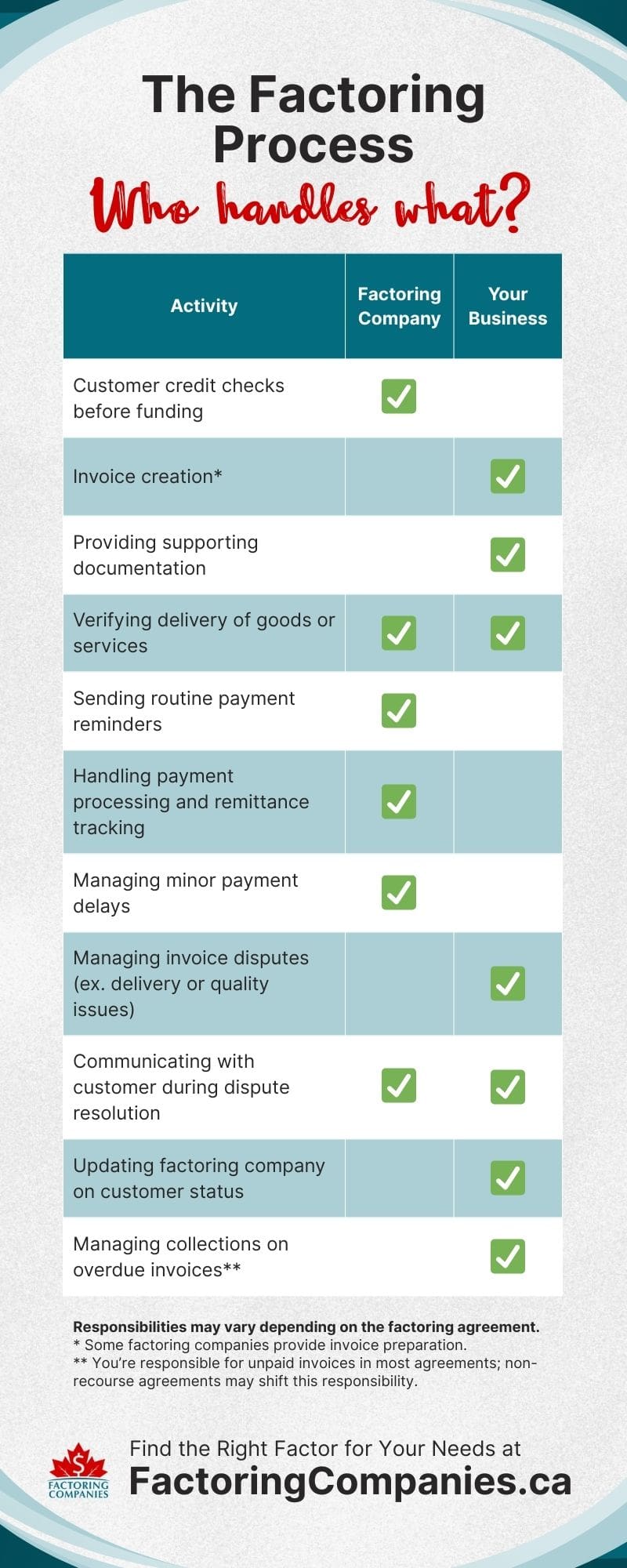
Before we get into how to manage client concerns about factoring, let’s start by exploring the relationship and points at which the factoring company might engage with your customer. Being familiar with these touchpoints will make it easier for you to set the right expectations with your customers and help them build trust in the new payment process.
1. Your Factor’s First Contact Will Generally Be Sending a Notice of Assignment
When you factor an invoice, you’re giving the factoring company the right to collect on it. In legal terms, your business is the assignor and the factor is the assignee. Canadian law requires that your client, the debtor, be notified of this arrangement. The document they receive is called a Notice of Assignment (NOA).
Provincial laws may also come into play and shape the broader framework about what the notice must say and how it is handled. However, it is generally very brief and touches on key points such as who is involved, which receivables are being assigned, and where to remit payment going forward. Most NOAs also request that the debtor acknowledge receipt and acceptance of the notice.
It’s worth noting that non-notification factoring does exist, but it’s the exception rather than the rule because, without an NOA, the factor cannot generally collect on the invoice. This changes the nature of the agreement and increases risk for the factor, so many do not offer it at all. Moreover, as risk increases, associated costs do as well, so it tends to have lower demand within the business community.
2. Your Factor May Reach Out to Verify Invoices
Virtually all factors have some form of invoice validation process. Their goal is simply to confirm that the charges are valid and that your customer is unlikely to dispute them.
Some factors still verify invoices manually by reaching out to the customer’s accounts payable department and asking. Others will prep the invoice for you and make sure it’s accepted before sending you your advance. Some will verify using your customer’s payment portal as well. And, many factors that offer industry-specific factoring solutions will accept alternate documents to show the charges are likely to be paid. For instance, trucking factoring companies routinely accept a signed bill of lading (BOL); those that focus on the temporary staffing industry may accept timesheets; and oilfield factoring companies commonly accept field tickets.
If direct contact is necessary, it’s very brief and professional, focusing only on validating the invoice. If other means are available, no direct contact is made. In rare cases where the customer disputes an invoice, the factoring company will generally reach out to your team, share the customer’s concerns, and allow you to resolve the issue before moving forward.
3. Your Factor May Follow Up as Needed to Support the Payment Process
Factoring companies specialize in collections, so their focus is on making it as easy as possible to pay. For this reason, they’ll often provide methods for customers to pay online and polite reminders, similar to how you might handle it in your own office. Some also accept phone payments or will make calls if the due date has passed. These are all handled courteously and professionally.
Most businesses have recourse factoring agreements. That means that, if your customer does not pay by a specific date, the invoice is transferred back to your business, and you take over the collections process from there. Because of this, their behavior is more like an outsourced billing agency rather than a debt collection company that uses strong-arm tactics to collect money on overdue bills. Their intent is to provide a good experience for your customer. By doing so, it strengthens your relationship with your customers and helps ensure an ongoing relationship.
Bear in mind, though, that depending on the nature of your factoring agreement and how your customers choose to pay, some will have no direct contact with the factor after acknowledging the NOA. They’ll simply send their payments to a new destination.
How to Manage Client Concerns About Factoring
Many of your customers are likely already familiar with invoice factoring, in which case, they’ll receive the NOA and follow suit as needed. Others may be more familiar with outsourcing, given that more than half of all businesses outsource at least some processes or tasks, per Statistics Canada. These contacts are more likely to overlook the factoring aspect and assume you’re outsourcing your billing or simply changing remittance instructions. However, you may still have concerns about perception and ensuring customers feel comfortable with the factor and confident in their next steps. Addressing a few areas proactively will help.
Choose a Factor That’s Known for Good Customer Service
To be fair, it’s in the factor’s best interest to treat your customers well. If your customers are happy, they’ll keep working with your business, and you’ll continue growing and factoring invoices. Good customer service is rarely a concern because of this. However, as you vet factoring companies, take time to read reviews and look specifically for details on how they handle customer contact. You can also ask the factor for sample communication, so you can see with your own eyes exactly what your customers will receive.
Educate Your Team
Talk to your team about the customer-facing aspects of factoring. Give them guidance on talking points and how to address concerns. It’s also helpful to have an internal process for escalating concerns. For instance, identify when customers should be referred to leadership for further follow-up, and have a process in place in case a customer does have an issue during the collection process.
Set the Tone Before the NOA is Sent
NOAs are clear and straightforward on their own, so no other communication is usually necessary. However, if you have concerns about specific clients or want to be sure key clients are prepared to work with the factor in order to accelerate funding and avoid bottlenecks.
It’s sometimes helpful to frame the new arrangement around how it helps you serve them better. For instance, perhaps it allows you to give them more generous payment terms or frees up your team to focus on core operations rather than collections.
How to Address the Most Common Questions and Pushback
It is incredibly rare to receive any type of pushback. However, if you do get unusual questions, it’s usually because the person has misconceptions about why businesses use factoring and how it impacts your relationship with them. We’ll go over a few examples of questions you might receive and how they can be answered below.
“Are You Having Financial Problems?”
Although it’s unusual for someone to ask this direct of a question, if someone does ask about your finances, it’s for two reasons. First, they probably don’t understand factoring well and are following one of the myths that only businesses in financial distress use it. Secondly, they’re most likely asking because they’re worried about the impact that might have on them. For instance, whether you might simply fail to deliver one day or if they’re going to try to connect with you down the road and find out the business is closed. Because of this, the question they’re really trying to answer is: “Do I need a backup plan or are you still reliable?”
And, you can answer this in whatever way seems appropriate for the situation. But oftentimes, you can simply say something like: “We’re doing great! But, you know, some clients pay slower than others, and this means we’re not waiting on their payments now.”
“Does This Change How or Who We Pay?”
Asking about remittance is not necessarily pushback, but sometimes it can be said with a bit of apprehension, so it’s good to address it head-on. In these cases, you can say something like, “Yes, we’ve got a great external team doing the collections now. You’ll see the new remittance instructions on a letter we’re sending out and on your invoices.”
Depending on the methods of payment the factor accepts, you can also share what you know. This can be especially helpful if the factor accepts more payment methods or makes it easier to pay in other ways.
“Are We Going to Be Pressured or Chased for Payment?”
Questions about aggressive collection methods are understandable, as some people confuse factoring with debt collection. In these cases, you can simply reassure them that you’re in alignment with the team managing collections and that they can expect top-notch service, but also let them know that they should reach out to you if they experience any friction at all. This helps reassure them that the service will be good, but you’ve still got their back if there’s an issue.
“Is Our Relationship Being Handed Off to Someone Else?”

Sometimes customers worry about how much involvement a third party will have, particularly if you’ve had a strong working relationship for some time. In these cases, it helps to reiterate that your company is still taking care of them. They’re still working with the same team and won’t experience any changes in service at all. The main difference is where they send the check at the end.
“Does This Affect Our Credit Standing with You?”
This question is a little harder to answer because the reality is that it might. Your factor will look into the creditworthiness of your customers and share guidance on limits and terms. Some of your accounts may not qualify for factoring, and some may qualify for less credit than you’re currently allowing. This is a risk-based assessment, so it’s generally best to follow their suggestions.
However, you often have choices in this arrangement. For instance, if a client seems riskier than others, you may be able to still factor their invoices and take a lower advance. Equally, you can continue working with the client as you always have, and simply not factor their invoices.
Know in advance what your strategy for each account is, so that they have a clear picture of what to expect.
Find the Right Factor for You and Your Customers
If factoring sounds like the ideal solution for you, we can match you with a vetted factor that has a strong track record for success. To get started, share a few details about your company.
FAQs on Client Concerns About Factoring
When I’m choosing a factoring company, how can I make sure they’ll take good care of my customers?
Start by checking the factoring company’s reputation. Look for online reviews that mention customer service and ask for sample communication. You can also talk to the factor about how they handle client interactions and what support is available if concerns come up.
What is the impact of factoring on customers?
For most, it simply means updating a remittance address. Some may get polite reminders or follow-ups from the factor, but all contact is professional and focused on keeping the payment process smooth.
What are some factoring transparency best practices in terms of talking to customers?
Give your clients a quick heads-up before the NOA is sent, especially if you anticipate questions. Make sure your team knows how to explain the change and reassure customers that nothing about your service or relationship is changing.
Should I be worried about customer relationships in factoring?
Not if you’ve chosen the right partner. Factoring companies want your clients to be happy too, so they’ll treat them professionally. Most clients view factoring as a normal part of doing business and continue the relationship without issue.
Does whether I choose recourse vs. non-recourse factoring impact how they interact with my customers?
Not usually. The interaction your customer has with the factor is generally the same either way. The difference between recourse and non-recourse mainly impacts what happens if your customer doesn’t pay.
Are there any factoring agreement terms that will signal that a factor provides good customer service?
Yes. Look for factoring agreement terms related to communication rights, dispute resolution, and how collections are handled. If a factor outlines clear, respectful contact practices and gives you visibility into what your customers experience, that’s usually a good sign.

About Factoring Companies Canada
 How to Implement a Cash Flow Management System for Your Business
 10 Times When Factoring for Large Companies is Vital
Related Insights






Get an instant factoring estimate
Factoring results estimation is based on the total dollar value of your invoices.
The actual rates may differ.
CLAIM YOUR FREE FACTORING QUOTE TODAY!
PREFER TO TALK?
You can reach us at
1-866-477-1778
Get an instant factoring estimate
Factoring results estimation is based on the total dollar value of your invoices.
The actual rates may differ.
CLAIM YOUR FREE FACTORING QUOTE TODAY!
PREFER TO TALK? You can reach us at 1-866-477-1778

